

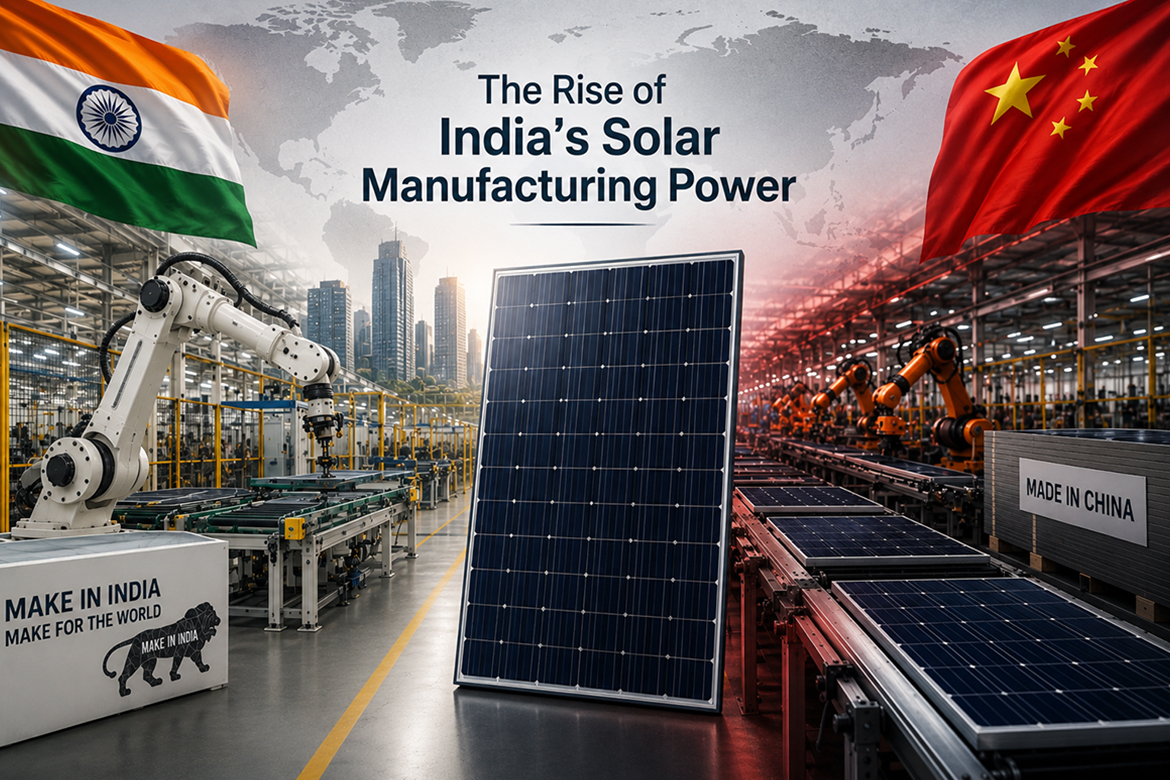
Introduction:
Ask any solar procurement director in Europe or the United States where their panels come from, and you'll get one answer almost every time: China.
That one answer tells you everything about how completely China came to dominate global solar manufacturing and why what's now happening in India deserves serious attention.
India is building manufacturing capacity at a pace the country has rarely matched in any industrial sector. Billions of dollars in committed investment. Government policy designed explicitly to create global-scale producers. A domestic market large enough to anchor that manufacturing base. And a growing global appetite from buyers who want exactly what India is positioned to offer: a credible, high-quality alternative to Chinese supply.
The question isn't whether India's solar manufacturing growth story is real. It is. The question is: how close are we to China and what would it actually take to close the gap?
The Gap Is Real – But So Is the Momentum
Let's be honest about the numbers first.
China currently accounts for over 80% of global solar module manufacturing, more than 90% of global solar cell production, and the overwhelming majority of polysilicon and wafer output that feeds the entire global supply chain. These are not market share figures, they are structural facts built over two decades of coordinated industrial policy, massive state financing, and aggressive cost reduction.
India's solar manufacturing capacity, by comparison, is a fraction of that. Module assembly capacity has crossed 60 GW, which sounds impressive until you realise China's is measured in the hundreds of gigawatts. India's solar cell manufacturing capacity sits at roughly 6–8 GW. Wafer and polysilicon production are still nascent.
So yes the gap is large. Anyone who tells you India is close to China in solar manufacturing today is not being straight with you.
But here's what the gap-focused narrative misses: India is not trying to replicate China's 20-year journey in five years. India is trying to build a credible, high-quality, globally trusted alternative manufacturing hub and on that measure, the momentum is genuinely significant.
How Did China Build Its Solar Manufacturing Dominance?
Understanding India's opportunity requires understanding how China got there.
China's solar manufacturing dominance didn't happen by accident. It was the product of deliberate, sustained, and heavily subsidised industrial policy starting in the early 2000s and accelerating through the 2010s. Provincial governments offered land, cheap power, low-cost financing, and direct subsidies. Massive domestic installation targets created captive demand that allowed manufacturers to scale. And as scale grew, costs fell creating a self-reinforcing cycle that eventually made Chinese solar panels cheaper than almost anyone else on earth could manufacture them.
The result was a global solar supply chain that runs almost entirely through Chinese factories from the polysilicon refined in Xinjiang to the wafers sliced in Jiangsu to the cells and modules assembled across the country.
That concentration made global solar cheaper. It also made the global clean energy transition dependent on a single country's supply chain decisions, a vulnerability that Western governments, Indian policymakers, and global procurement teams are now actively trying to reduce.
Where Does India's Solar Manufacturing Capacity Stand Today?
India's solar manufacturing ecosystem has two distinct layers, and it's important to understand both.
India's Module Assembly vs Cell Manufacturing Reality
At the module assembly level, India has built genuine scale. With over 60 GW of module manufacturing capacity, India ranks among the top module producers globally. Several Indian manufacturers operating at gigawatt scale are producing quality modules that are competitive on the international stage.
The gap emerges further up the value chain. Solar cell manufacturing, the more capital-intensive and technology-demanding step, remains limited at 6–8 GW of domestic capacity. Wafer slicing and polysilicon production are at even earlier stages of development.
This means India is currently strong in the downstream, assembly-intensive part of solar manufacturing but still dependent on imports, primarily from China, for the upstream components. ALMM List II is specifically designed to address this by mandating domestic cell sourcing for government-linked projects, but the capacity needs to be built first.
What Is Driving India's Solar Manufacturing Growth?
The short answer: policy, investment, and necessity in that order.
The PLI Scheme (Production-Linked Incentive) for high-efficiency solar modules has been the most direct accelerant. With committed incentives across Phase I and Phase II, the scheme has attracted manufacturers to invest in integrated solar manufacturing including cells, wafers, and in some cases ingots. Several large Indian industrial groups and dedicated solar companies have announced multi-gigawatt integrated manufacturing facilities with timelines through 2025–2028.
The PLI Scheme's Role in Building Manufacturing Scale
The PLI Scheme isn't just a subsidy, it's structured as a performance incentive. Manufacturers only receive payments when they actually produce and sell qualifying high-efficiency modules. This creates a direct link between investment and output, reducing the risk of capacity sitting idle. The result is that India's solar manufacturing investments are, by design, tied to real commercial production.
Domestic demand is the second major driver. India's own renewable energy targets 500 GW by 2030 represent an enormous captive market for domestic manufacturers. Unlike many export-led manufacturing strategies that depend on foreign demand, Indian solar manufacturers have a home market large enough to anchor their entire business case. This makes the economics of building manufacturing capacity in India fundamentally more robust than in smaller markets.
Energy security is the third driver, and perhaps the most durable. India's policymakers are acutely aware that a solar transition built on Chinese supply chains is a strategic vulnerability. The ALMM mandate, DCR requirements, and import tariffs on solar modules and cells are all expressions of the same logic: India will pay a short-term cost premium to build long-term supply chain independence.
Can India Compete With China on Solar Technology?
This is the question that will define India's solar manufacturing future and the honest answer is: increasingly, yes.
TOPCon and N-Type: Is India Keeping Up With the Technology Curve?
The global solar industry is in the middle of a technology transition. Conventional PERC cells which dominated module production for most of the last decade are being rapidly displaced by higher-efficiency technologies, principally TOPCon (Tunnel Oxide Passivated Contact) and HJT (Heterojunction Technology) cells. N-Type solar modules, which underpin both TOPCon and HJT architectures, are becoming the new market standard.
Chinese manufacturers moved into TOPCon at a massive scale in 2023–2024, driving down costs rapidly. The concern for Indian manufacturers is whether they can keep pace with this technology curve or whether they build capacity in older technologies that become uncompetitive before they recoup their investment.
The encouraging news: several Indian manufacturers are investing specifically in TOPCon and N-Type cell manufacturing capacity. The PLI Scheme's efficiency thresholds are calibrated to incentivise high-efficiency production, not legacy technology. India is not arriving late to the TOPCon transition; it's building its cell manufacturing base around it.
This is a meaningful difference from building PERC capacity in 2024. It means Indian solar manufacturing, as it scales, is oriented toward the technologies that will define the industry through 2030 and beyond.
How Is India Positioning Itself in the Global Solar Supply Chain?
Export Ambitions: Can India Become a Global Solar Supplier?
India's solar manufacturing ambitions are not purely domestic. The global appetite for non-Chinese solar supply has never been stronger driven by US tariff policy, European supply chain due diligence requirements, and private sector ESG commitments around supply chain transparency.
India is actively positioning itself to serve this demand. Solar exports from India have grown meaningfully, with the US being a key destination for Indian-made modules. The combination of quality manufacturing, English-language business environment, transparent regulatory framework, and geopolitical positioning makes India an attractive alternative for buyers looking to diversify away from China.
This isn't charity from global buyers, it's strategic procurement. Markets that need reliable, non-Chinese solar supply at competitive quality are genuinely looking to India. The opportunity is real, and several Indian manufacturers are already capitalising on it.
What Are the Real Challenges India Must Overcome?
A balanced picture requires confronting the challenges directly.
Cost competitiveness remains the central issue. Chinese solar manufacturing benefits from lower input costs, more established supplier ecosystems, and economies of scale built over decades. Indian manufacturers are still climbing that cost curve. For purely price-driven procurement decisions, Chinese modules will remain cheaper for some time.
Upstream integration is the structural gap. India needs significant investment in polysilicon, wafer, and ingot production to truly reduce its upstream dependency. Without that, Indian module manufacturers are still exposed to Chinese supply chain decisions at critical chokepoints.
Capital access is a real constraint, particularly for mid-sized manufacturers who want to move into cell and wafer manufacturing. The capital requirements are substantial, loan tenors need to be long, and lender appetite for complex manufacturing businesses requires development.
Skilled workforce is an underappreciated bottleneck. High-efficiency cell manufacturing, especially TOPCon and HJT, requires specialised engineering talent. Building that workforce takes years, not months.
None of these are fatal constraints. But they are genuine, and they will determine the pace at which India closes the gap with China.
Conclusion: India Won't Be China – It'll Be Something Better
Here's the reframe that matters: India doesn't need to replicate China's solar manufacturing model to win.
China built dominance through volume, speed, and cost. India's opportunity is different: to build a manufacturing ecosystem defined by quality, compliance, supply chain transparency, and strategic reliability attributes that a growing share of global solar buyers are willing to pay a premium for.
The domestic market gives India a captive demand base that few other countries can match. The PLI Scheme is funding the capacity investment. ALMM and DCR policies are ensuring that domestic capacity has a guaranteed market. And the global diversification trend is creating export demand that India is uniquely positioned to capture.
By 2030, India's solar manufacturing capacity, if current investment commitments are delivered, could reach 100 GW of modules and 40–50 GW of cells, making it a genuine second-tier global manufacturing power. Not China's size, but a credible, trusted alternative with its own industrial logic.
For manufacturers, developers, EPC companies, and investors operating in this space, the direction is clear. India's solar manufacturing ecosystem is being built in real time and the companies that invest in it now, rather than waiting for it to be fully formed, will define what it becomes.
At Aatmanirbhar Solar, we're building modules in India for India's future and increasingly, for the world's. Because the cleanest supply chain isn't always the cheapest one. It's the one you can actually rely on.